
Open Letter to Peers
Please Test Energy Filament Theory (EFT)—and Try to Falsify EFT
On EFT’s Positioning, Boundaries, and Open Invitation
To peers, researchers, reviewers, and everyone who cares about fundamental science:
Before you enter EFT’s experiment page, we would like to clarify EFT’s positioning, the practical limits of our team, and why we are openly inviting third-party teams around the world to test it. EFT should not be treated as a theory that asks others to “believe first and discuss later.” It must be examined, compared, tested—and even subjected to attempts at falsification.
I. Why EFT Deserves Serious Attention
In comparisons framed around the goal of an “underlying operating manual for the universe,” several mainstream AI systems have rated EFT highly. In dimensions such as “physical realism,” “grand-unification potential,” and “simplicity,” EFT shows clear advantages over the full set of contemporary physical theories.
It must be made clear: high AI scores do not mean EFT has been proven correct. AI evaluation cannot replace data, experiments, or peer review. It is closer to a structured preliminary review: it helps readers quickly compare whether a theory has a clear underlying mechanism, a unified picture, and an explanatory chain that can be questioned.
But this preliminary review says at least one thing: EFT is not an idea that can be dismissed casually. It offers a candidate framework with strong explanatory power, strong mechanistic intuition, and enough substance to merit a place in scientific discussion. EFT may be wrong, but it deserves to be treated seriously.
II. EFT’s Positioning: Supplying the Missing “Operating Manual for the Universe’s Underlying Mechanisms”
EFT’s positioning has already been stated clearly on the download page: EFT does not seek to replace contemporary physics wholesale, nor does it deny mainstream physics’ successes in mathematical calculation, engineering applications, and experimental verification. Its role is to add, beneath contemporary physics’ highly successful high-level computational system, an “operating manual for the universe’s underlying mechanisms.”
Today’s mainstream physics has accumulated exceptionally rich and valuable achievements in high-precision calculation, engineering application, experimental interfacing, and numerical simulation. EFT does not deny those achievements, nor does it seek to negate their validity.
In other words, modern theories continue to carry high-precision calculation, comparison with experiment, engineering applications, and technical extension. EFT is more concerned with whether, beneath these successful descriptions, we can add a deeper picture of what is actually happening.
For that reason, EFT and contemporary physics are better understood as working in vertical cooperation and complementing one another, rather than as competitors in a zero-sum replacement.
EFT’s scientific value lies not only in its attempt at theoretical unification; it also has a science-communication dimension. It seeks to reorganize many highly abstract and fragmented modern concepts into a picture with stronger imagery and clearer lines of questioning.
III. Boundaries of the Experiment Page: This Is Not a “Proof Page,” but a “Reproducible Entry Point”
We have placed the experiment page on the public website not to announce that EFT has been fully proven. On the contrary, the purpose of the page is to set out, first, the parts of EFT that can be observed, calculated, reproduced, and refuted, so that outside teams can inspect them directly.
For example, the P1 series reports discuss average gravitational response and cross-probe closure tests in specific observation windows. They are not a final proof of the entire EFT theory, and they should not be read simplistically as “all dark-matter models have already been overturned.” Such boundaries must be clear, or any result can be misused.
We therefore prefer that readers understand this page as an open testing checklist: which conclusions have already entered reproducible material, which remain theoretical inferences, and which require stronger data, stricter models, and more independent teams to decide.
IV. How EFT and Contemporary Physics Complement Each Other
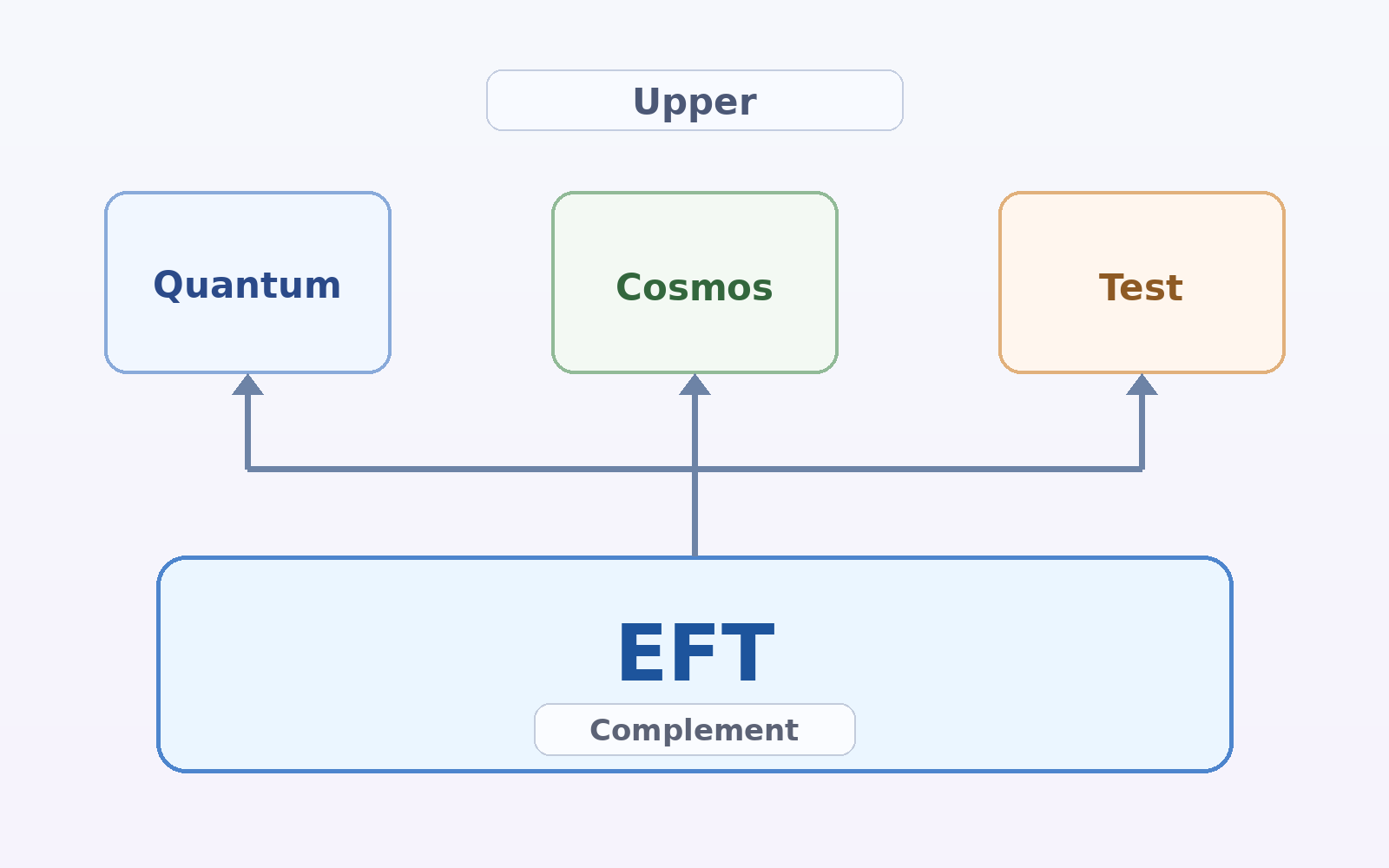
Figure note: EFT sits at the “underlying” level. Its role is not to replace contemporary physics, but to add an “operating manual for the universe’s underlying mechanisms” beneath the high-level theory and application systems that have already proved highly successful. The upper layers—quantum theory, cosmology, and experimental applications—continue to perform their own roles; EFT provides deeper explanation, a unified base map, and falsifiable pathways.
V. The Real Limits of a Small Team Do Not Mean Avoiding Tests
The EFT author team has long remained a team of fewer than ten people. Our funding, resources, networks, experimental conditions, and organizational capacity cannot compare with those of a mature large academic community. When a very small team devotes substantial energy to theoretical construction, knowledge-base organization, public writing, and the design of falsification pathways, it has no choice but to adjust the pace of experimental verification to what it can realistically handle.
This is not to say that EFT cannot withstand scrutiny, and certainly not that it is trying to avoid scrutiny. It is simply a basic reality: one cannot demand that a very small team, in a very short period of time, complete a systems-engineering task that depends on large numbers of researchers, huge funding, complex instruments, and collaboration networks built over decades.
Therefore, expecting the EFT author team alone to carry the tasks of “large-scale mathematical completion + large-scale independent experimental verification” is neither realistic for the team nor consistent with EFT’s current positioning. EFT will continue to focus on underlying explanation, conceptual unification, public falsification pathways, and experimental clues that third parties can directly take up.
VI. Why EFT Has Not Produced Many Formal Reports in Traditional Academic Circles
Many people will naturally ask: if EFT deserves attention, why are there not many formal reports on it in traditional academic circles? One practical reason is that the EFT author does not have an institutional email address or recommendations from within the traditional institutional system, and therefore cannot access the basic registration and dissemination channels of some traditional academic platforms.
A deeper reason has to do with the author’s personality and intellectual choices. The author chose the path of EFT in the first place in order to free himself, as far as possible, from the constraints of existing frameworks and to focus on direct observation, imagination, and reconstruction of the unknown world. The author is unwilling to accommodate mechanisms that place extra gates in front of scientific communication or bind the right to speak in advance to institutional status, because that would run against the open spirit EFT tries to uphold.
This does not mean that EFT rejects scholarly exchange. On the contrary, EFT has chosen a more public path: through a public website, a static knowledge base, DOI archives, reproducibility materials, an experiment page, and public explanations, it places the theory and its testing pathways directly before the world, so that anyone can read, question, compare, and review them.
VII. What We Hope Third-Party Teams Will Do
We welcome third-party teams to begin with the easiest checks: reproduce existing reports, inspect the data-processing workflow, replace the model baselines, add stricter negative controls, use different statistical protocols, or design new tests in new observation windows.
We also welcome stronger theoretical criticism: identify internal contradictions in EFT, dismantle key assumptions, offer stronger mainstream explanations, or propose new experiments that can clearly decide between EFT and competing models.
If EFT is wrong, please use data, experiments, and logic to falsify it clearly. If EFT is only partly right, please help extract what is genuinely valuable and turn it into public knowledge.
VIII. Open Invitation: Please Verify EFT—and Please Try to Falsify EFT
The central attitude behind this open letter is very simple: EFT welcomes global teams to verify it, and it also welcomes global teams to try to falsify it.
The true vitality of a theory does not lie in whether it can defend itself, but in whether it can expose itself to the most public, rigorous, and reproducible tests. EFT is willing to face such tests, and it is willing to accept the revisions, reservations, or even elimination that may follow.
If you are willing to participate, please treat EFT as an open problem, not as the banner of a camp: test it, challenge it, revise it, surpass it, or falsify it. This is not harm done to EFT; it is the path EFT must travel if it is to truly enter the public domain of science.
EFT Working Group
May 2026